Workshops
I have all sorts of workshops available, so please take a look and call or email me if you are interested in knowing more, or would like to book.
Workshop Dates by Email
If you would like to receive my email newsletter keeping you informed of workshops, events and all the latest news regarding my work then please sign up here .
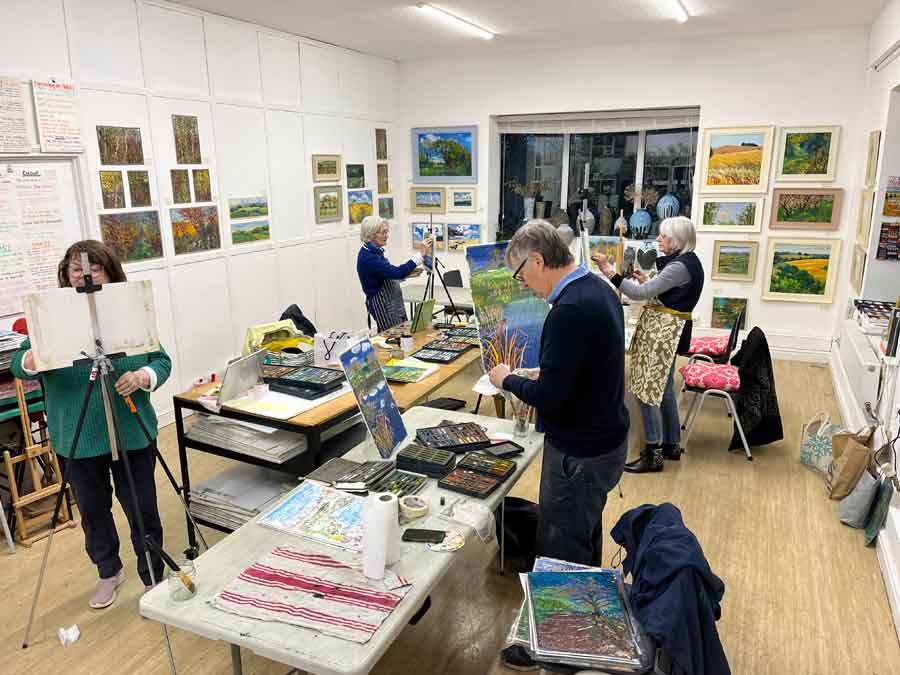
Pastel Workshops
Soft pastel is an amazingly versatile, contemporary medium which works beautifully on its own or with mixed media. It is painting and drawing all in the same action and so very tactile as a painting medium.
All my workshops are small, so they are friendly and intimate. I do some demonstrations to give students an idea of what's going to be happening and although fun, the workshops are informative, focusing on working hard and getting a lot done!
The idea behind all my tuition is to increase a student's confidence and knowledge of using pastels as a medium, whether they are a beginner or an experienced artist. None of my teaching will turn anyone into a photo-realist painter, as I believe strongly in developing an expressive and emotional individual style.
Workshops for Everyone
I offer a variety of workshops in Rowde near Devizes Wiltshire for absolute beginners to experienced artists. Some workshops are single standalone sessions, others are run as courses and I am also happy to design the tuition around your particular pastel needs.
Please see below for detailed descriptions of the different pastel workshops I offer and the latest dates.
Which Workshop?
If you have ever thought you would like to have a go at using soft pastels, or are lacking the confidence to even take your labels off and snap your pastels in half, then why not try one of my one-to-one Pastel Sessions?
Alternatively, if you are an established artist and think you know pastels, think again. Or if you are a bit rusty with your pastel techniques. Choose a single Pastel Session to focus on a particular subject or technique. I also offer a number of different workshops, showing you a wide range of techniques and papers and covering various subject areas.
How many different pastel papers have you tried? Starting with a number of papers helps to build your knowledge of texture straight away. Learn all about mark making, sgraffito, alcohol/pastel underpainting and paper texture tests. All useful and surprising techniques, which will bring striking results.
Which Pastels?
I have designed and Unison Colour, who make extraordinary pastels, have produced a number of sets specifically for my workshops.
Workshop Venue

Elm Studio at the Mind Tree Café
My pastel studio and workshop space, Elm Studio is located at the Mind Tree Café Furlong Close Rowde SN10 2TQ Wiltshire.
Elm studio can accommodate 8 students and I also have access to a larger workshop space at this same venue.
Soon both studios will be air conditioned in the Summer and are already heated in the cooler months. So providing a comfortable painting environment all year round.
Please take a look at the latest workshop dates and book by phone or email.
The Workshops

Colour Theory
When you are using paint you can easily mix your primaries and see how they make some secondary colours. Whereas pastels are all powder, so we have our colours made for us already.
But we still need to know what's cool, what's warm, what's light, what's dark and everything else. So really understanding the different emphasis of colour theory for pastels is a vital part of painting with and using them.
This standalone whole day workshop is a great opportunity for beginners or experienced artists, who simply need a refresher, to gain, or renew your knowledge, experience and confidence in using colour and knowing its construction.


Art Movements
At each of the Art Movement workshops, I will discuss the themes and methods of the various artists involved and together discuss ways to explore a new approach to using your pastels. I will include mini demonstrations during the morning and give you time to plan your compositions through sketches and notes working towards a final, larger piece of work in the afternoon.
Looking at historic painters and styles allows us to see how to push ideas and develop them beyond the obvious. As an artist, being open to exploration of a medium is so important. Not only does it increase your knowledge of what that medium can do, but it also encourages a more personal experience of it. Ultimately, this will encourage you to find out exactly which processes are both enjoyable and useful towards achieving the finished result of a painting in your own recognisable style.
Fauvism
Fauvism was one of the most exciting, influential and short lived Art Movements of the 20th Century (1905 to 1908). Henri Matisse described it as “A rejection of imitation in favour of pure, expressive, colour to create strong emotional reactions.” We will look at the loose brushwork and non-naturalistic palettes of Henri Matisse, Maurice de Vlaminck, Andre Derain and others to inspire us with our own compositions using soft pastel.
Post Impressionism
Post Impressionism was a French Art Movement from c.1886-1905, which was reacting against painting in a naturalistic way, as practised by the Impressionist painters. Artists such as Paul Cezanne, Paul Gauguin, Vincent van Gogh, Georges Seurat among others, were finding a more individual response to their surroundings, which experimented with the effects of colour, shape, composition and technique. The tradition of realism was of much less importance than painting as a visual statement of expression.
Cubism
Cubism was an early 20th century Art Movement, which began in Paris around 1907, with artists such as Pablo Picasso, Georges Braque, Juan Gris and Fernand Léger. Typically the subjects of landscape, still life, figures and portraits were deconstructed and reassembled as flattened shapes or facets. They may or may not have a resemblance to the original subject, often incorporating an experience of the whole subject, seen at once rather than a single viewpoint.
Abstract Expressionism
Abstract Expressionism was an Art Movement developed in America 1940s-1950s, which explored mark making and the technique of applying colour to surface by unconventional means, for a totally abstract or non-representational result. Artworks might capture a mood, feeling or visual sensation and we start to see “Untitled” being given to works of art. Two main areas for discussion are: Action Painters such as Jackson Pollock, Willem de Kooning and Franz Kline and Colour Field Painters such as Mark Rothko, John Hoyland and Morris Louis.


Still Life
Still Life provides such a wonderful opportunity for painting, because there are everyday objects around us, wherever we are. A great passion to ignite in all artists!
Each session in this series of standalone workshops will focus on a different aspect of the pastel painting of still life. Improving our observational skills in terms of lighting and colour and developing our artistic eye. Then learning how to complete the painting using pastels.
The first workshop will look at Painting Coloured and Clear Glass, the second Bottles and Fruit, the third Flower in Glass Vase and the fourth Big, Colourful Still Life.
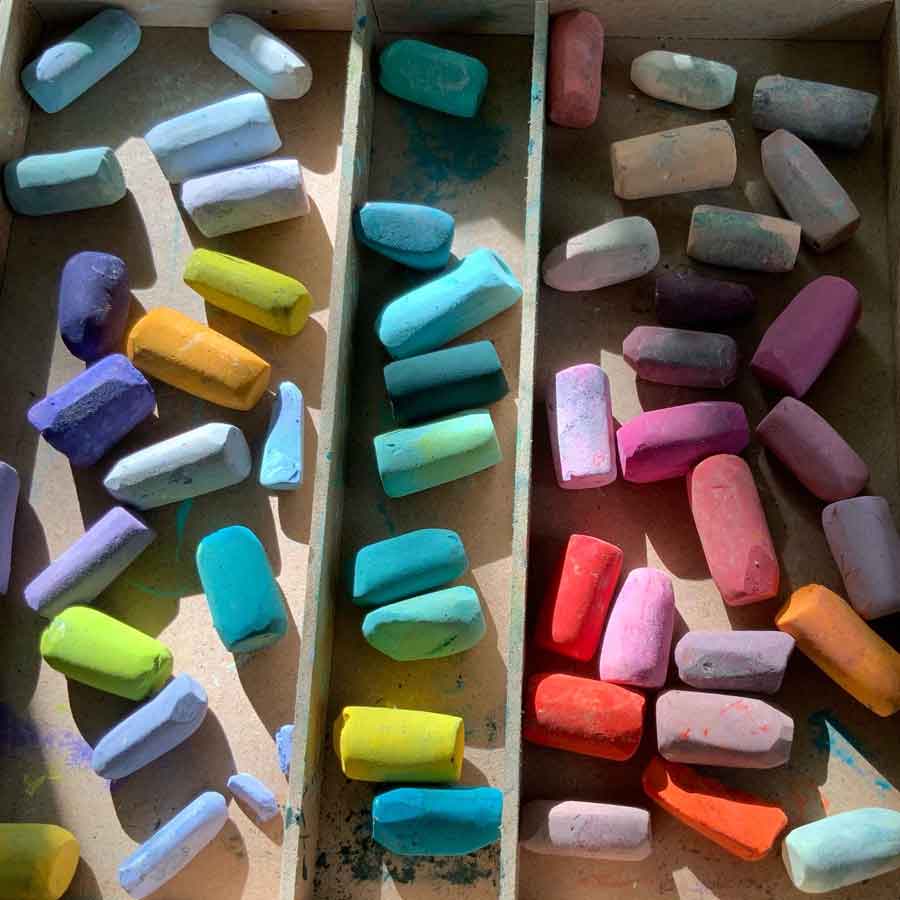
Pastel Session
This is a single 3 hour session intended to give you a taste of pastel techniques if you are a beginner or new to this medium, or to focus on a particular subject or techniqiue if you are a more experienced artist.
If you are not sure about joining a workshop, this is an opportunity to have a one-to-one to see what pastels are all about, to get a feel for them before committing to a workshop or course.
A Pastel Session is a fun idea for a birthday present or ideal to concentrate on for example learning or improving pastel mark making, landscape or still life.
I also offer the sessions for 2 people at a reduced price, please see below.


I would never have had the courage to ditch working from a photo reference without you. Thank you so much for that.
Friday Pastel Studio Membership
Introducing a new membership for intermediate to advanced pastel students. The idea being to give your pastel painting practice regular, dedicated time on Fridays in my spacious Elm Studio here in Rowde.
This membership will give you unlimited access to Friday studio time, during which you may work on your own projects, landscape, seascape, still life, floral etc with as much, or as little guidance from me as you wish.
Just pay your fee each month by standing order and book your chosen dates in advance. Terms and conditions apply.
Bring your pastels, paper and project and enjoy unlimited studio access every Friday, with like minded people, who while offering friendship and support, also respect your need for time to concentrate and focus on your own work.
You will benefit from:
- Unlimited Friday access to the studio between 10am and 5pm
- Heated studio providing a comfortable painting environment
- Dedicated studio painting time within a group of committed fellow pastel painters
- Guidance and advice from me throughout your projects as needed
- Framing, presentation, portfolio advice for those applying for competitions/exhibitions
- Easels and other studio equipment available
- Art books and pastel magazines for inspiration
- Plants, dried seed heads, colourful pottery, other objects and cloths for still life set ups
- Orchard and garden available for students to work outside when possible
- Pastel and paper ordering advice
- Technique demonstrations upon request
- Critiques/appraisals of work as requested


Pastel Techniques
This course is just as suitable as a refresher for an artist who hasn't touched their pastels for a long time or has always wanted to have a go at painting with pastels, as it is for an absolute beginner.
The idea of these workshops is to develop a student's dexterity and skills with pastels and a variety of papers.
During the course I will cover all techniques, basic to advanced and experimental mark making. Mark making being a fundamental building block in art and is how you begin to express emotion and movement.
We will explore scraffito, liquid/pastel under painting, blending and knowing when to stop to allow a pure mark to shine through, basic colour theory and when and how to use different pastel paper textures, including specialist papers for their expertly designed surfaces.
At the end of the course, you will have all the information on papers and techniques you need to start to practice on your own and be able to slot into any of my other workshops.


Colour Theory 1
When you are using paint you can easily mix your primaries and see how they make some secondary colours. Whereas pastels are all powder, so we have our colours made for us already.
But we still need to know what's cool, what's warm, what's light, what's dark & everything else. So really understanding the different emphasis of colour theory for pastels is a vital part of painting with and using them and is why I have developed this sequence of 3 full day workshops.
In the first workshop, we will look at how to identify colour and how to create it. For example we will look at something like the colour beige and if we imagine just our primary colours, a black and a white, how are we going to actually physically make beige?
We will explore a colour's temperature, tone and purity. Whether it's a vibrant, dull, bright, subdued, saturated or desaturated colour. Essentially, we will deconstruct the colour, so we know how to re-create it.
A great opportunity for beginners or experienced artists, who simply need a refresher, to gain, or renew your knowledge, experience and confidence in using colour, knowing its construction.
Included in the cost of the course is a set of 18 pastels. Primary, secondary and tertiary colours I have picked out from the colour wheel. There are 12 colours which make up the colour wheel and I have also included a black, a white and 4 greys to use throughout the course of 3 workshops.
The Colour Wheel set is a beautiful selection and will complement any pastels you may already have.

Colour Theory 2
An essential element of colour theory is colour relativity.
In this second workshop, among other practical exercises, we will observe a simple still life subject, experimenting with a variety of colour palettes to witness the changing relationships between the chosen colours.
Students will need to have attended the Colour Theory 1 workshop and we will use the Colour Wheel set of pastels from the first workshop.

Colour Theory 3
How do we make use of colour theory in our pastel painting practice?
In this third workshop, from your own photo or sketch, I will guide you through the process of using your knowledge of colour and technique to create a balanced and expressive piece of work, liberating you from the static procedure of simple copying.
This will open up your artwork generally for further development.
Students will need to have attended the Colour Theory 1 and 2 workshops and we will use the Colour Wheel set of pastels from the first workshop.


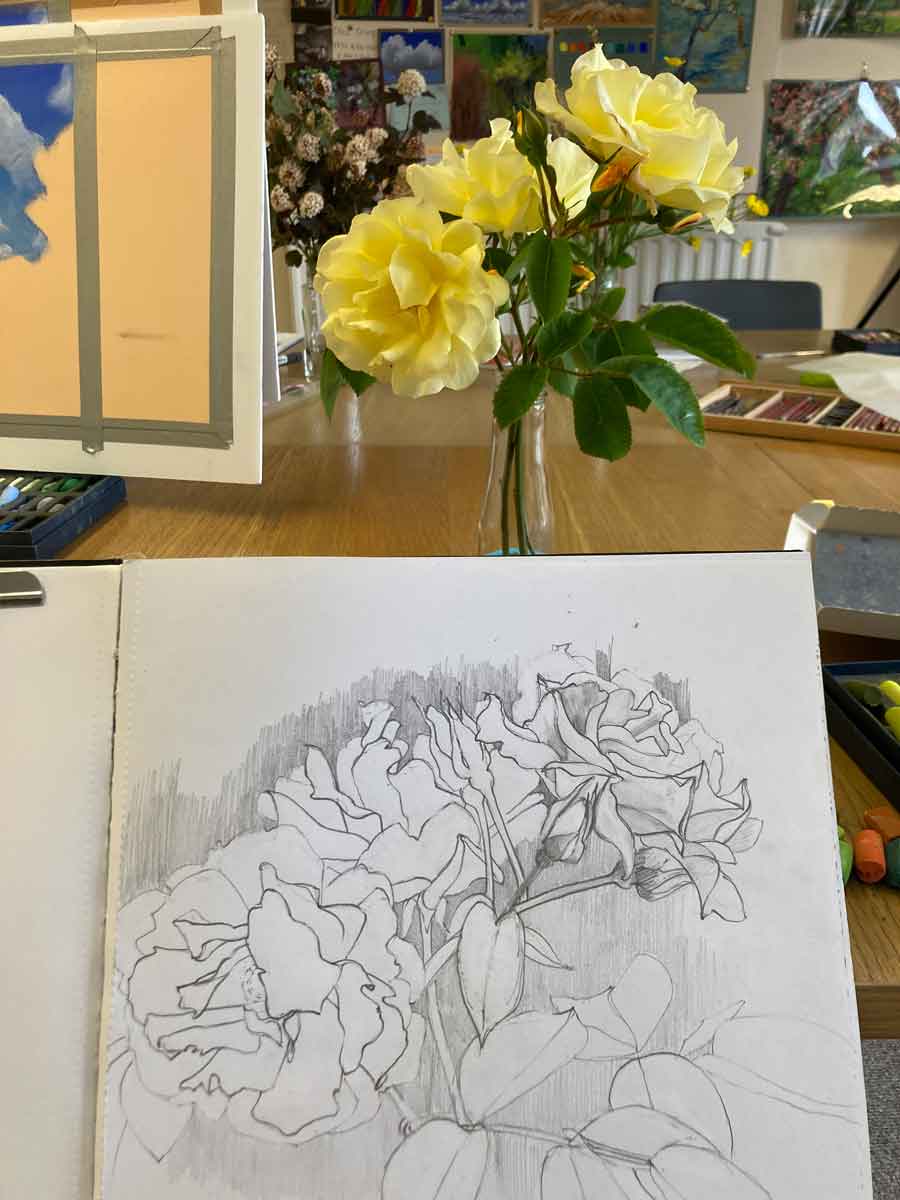
Learn to Draw and Learn to See
Using both line and colour, we will observe natural and man made objects from life in the studio, spend time in the orchard and also, weather permitting, at Caen Hill.
I will show you how to achieve accuracy, whilst developing your observational skills to understand form in order to represent it convincingly. An essential element of art in all mediums and disciplines you choose to practice.
The Workshop Calendar
September
Date
Time
Workshop
Venue
Friday 4th
10am - 5pm
Friday Pastel Studio Membership
Mind Tree Café
Saturday 5th
10am - 4pm
Still Life Series: Bottles and Fruit
Mind Tree Café
Friday 11th
10am - 5pm
Friday Pastel Studio Membership
Mind Tree Café
Saturday 12th
10am - 4pm
Pastel Techniques Course: Pt 1
Mind Tree Café
Friday 18th
10am - 5pm
Friday Pastel Studio Membership
Mind Tree Café
Saturday 19th
10am - 4pm
Pastel Techniques Course: Pt 2
Mind Tree Café
Friday 25th
10am - 5pm
Friday Pastel Studio Membership
Mind Tree Café
Saturday 26th
10am - 4pm
Pastel Techniques Course: Pt 3
Mind Tree Café
October
Date
Time
Workshop
Venue
Friday 2nd
10am - 5pm
Friday Pastel Studio Membership
Mind Tree Café
Saturday 3rd
10am - 4pm
Still Life Series: Flower in Glass Vase
Mind Tree Café
Friday 9th
10am - 5pm
Friday Pastel Studio Membership
Mind Tree Café
Saturday 10th
10am - 4pm
Standalone Workshop: Colour Theory
Mind Tree Café
Friday 16th
10am - 5pm
Friday Pastel Studio Membership
Mind Tree Café
Saturday 17th
10am - 4pm
Art Movement Series: Fauvism
Mind Tree Café
Friday 23rd
10am - 5pm
Friday Pastel Studio Membership
Mind Tree Café
Saturday 24th
10am - 4pm
Still Life Series: Big, Colourful Still Life
Mind Tree Café